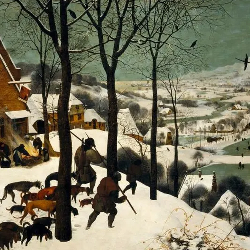
I was reading an about page from an algorithm-free social media platform when I came across the following: "When Wall Street firms (like BlackRock and Securitize) look at the world, they see physical assets to be tokenized and traded. When Silicon Valley looks at the world, they see psychological assets to be harvested.
Current social media platforms operate as massive extraction facilities. Your data, your location, your private conversations, and your behavioral tics are scooped up, packaged, and sold to advertisers, data brokers, and surveillance apparatuses. You are the product yielding the compound interest."
That clicked with me immediately. Many social media platforms don't even need your IP to recognize who you are, given device fingerprinting methods. I really do feel like we're seen as the product, as livestock, tagged and tracked by detailed profiles built on all the data we leave behind while interacting on the Internet.
I want to figure out ways to communicate my thoughts about this more clearly and succinctly, so that it can be shared with your average person who doesn't go much deeper than Instagram or Facebook but recognizes there's something messed up about it, maybe to get pamphlets made in the future to share around local towns. Don't worry, I won't go full towncrier mode, just maybe find some small cafes and bookshops that will take a stack of them.
Users as Tokenized Assets
Moderator: Onio
Re: Users as Tokenized Assets
I should disclaimer what I've written below by saying that it's only my opinion based on personal and anecdotal experience.
But, it's my impression that everyone I talk to about social media here in the UK already knows social media harvests and exploits their data but accepts it, and sees it as a trade for being part of some type of communications network.
When I say to a friend: "you could get rid of facebook or instagram" the response is actually a lack of trust in an alternative for sharing photos or for seeing how people are (status updates), or it's even as though people have forgotten email and other messaging exists.
Overall, I feel like a pamphlet would, if it were comprehensive become a fully fledged and researched non-fiction book on social media addiction like The Chaos Machine, by Max Fisher (2022) or Stolen Focus, by Johann Hari (2022) neither of which I've read but I've read write-ups that make it seem like they cover:
I got rid of Facebook years ago and then Instagram and WhatsApp this year, so I have zero social media now. The accounts still exist but I stopped using them because I got a terms and conditions prompt on Instagram that I didn't want to accept (and accepting to continue using the platform was the only option it gave me.)
Instagram didn't give me the option of not accepting the terms and deleting the data, only of accepting either paid version or continuing with the new terms on the free version.
So simply putting down the phone and saying no, was the only way to not accept the new terms and conditions. I then deleted the app.
But the account itself still exists, I just cannot access it, because I didn't accept the terms.
I think all my friends and family would not have done what I did, they would have accepted the new terms with a single click and continued to use Instagram, not because they don't know their data is being harvested but because they do know and just accept the trade.
But, it's my impression that everyone I talk to about social media here in the UK already knows social media harvests and exploits their data but accepts it, and sees it as a trade for being part of some type of communications network.
When I say to a friend: "you could get rid of facebook or instagram" the response is actually a lack of trust in an alternative for sharing photos or for seeing how people are (status updates), or it's even as though people have forgotten email and other messaging exists.
So, I think your hypothesis that they don't know they are being data farmed, and a pamphlet would help them to know this, is not quite right. I think they do know. I think the world at large is aware that:...maybe to get pamphlets made in the future to share around local towns.
Another reason some people actually want social media, is they have dopamine hits from it, and we get addicted to things, whether we can rationally acknowledge that or not. So, we know scrolling Instagram is addictive and mindlessly doing so is common? But saying, I'm going to stop because I don't want my data harvested is rational, and not necessarily a meaningful oppositional position to addiction.Current social media platforms operate as massive extraction facilities. Your data, your location, your private conversations, and your behavioral tics are scooped up, packaged, and sold to advertisers, data brokers, and surveillance apparatuses. You are the product yielding the compound interest.
Overall, I feel like a pamphlet would, if it were comprehensive become a fully fledged and researched non-fiction book on social media addiction like The Chaos Machine, by Max Fisher (2022) or Stolen Focus, by Johann Hari (2022) neither of which I've read but I've read write-ups that make it seem like they cover:
- data harvesting
- algorithmic amplification
- recommendation systems
- addiction by design
- misinformation
- polarization
- internal research from tech companies
- smartphones
- social media
- dopamine
- ADHD research
- sleep
- multitasking
- surveillance capitalism
I got rid of Facebook years ago and then Instagram and WhatsApp this year, so I have zero social media now. The accounts still exist but I stopped using them because I got a terms and conditions prompt on Instagram that I didn't want to accept (and accepting to continue using the platform was the only option it gave me.)
Instagram didn't give me the option of not accepting the terms and deleting the data, only of accepting either paid version or continuing with the new terms on the free version.
So simply putting down the phone and saying no, was the only way to not accept the new terms and conditions. I then deleted the app.
But the account itself still exists, I just cannot access it, because I didn't accept the terms.
I think all my friends and family would not have done what I did, they would have accepted the new terms with a single click and continued to use Instagram, not because they don't know their data is being harvested but because they do know and just accept the trade.
Re: Users as Tokenized Assets
Thank you for your thoughts on this, I think you're right, a lot of people do know. At the same time, I think there are also a lot of people (at least where I live) who don't know, who don't realize just how much information is gathered from us, or how it's gathered by our web and social media activity, why that's harmful and how it is used against them. Then I think there are another subset of people who try not to think about it because they don't even know how to approach it.
But informing people about that would be secondary to pointing out there are things we can do about it, that there are options. I think so many people who do know, don't think there's another choice but to sign up for the ride, and I'd like to claw out every option we have to not sign up for the ride, and present them to the public, alongside the information that reminds them why they might not want to get on that ride.
For instance, I had several people comment on my indie web video who just didn't get the premise, they said self-hosting never went away, that we were always able to make websites. If that were the point of the video, it wouldn't have gone viral. It went viral because so many people didn't realize there was an active movement and large community of people connecting and interacting across decentralized, citizen-owned platforms (in the form of websites). Even myself, until I found the indie web myself, I never would have thought there was an active community of tens of thousands of users interconnecting across personal websites. And so that's largely what the pamphlet would be about - showing people what is out there, because I think so many people just don't know about the alternatives or how to find them.
All-in-all, the pamphlet idea is just an idea, I don't think I even have the bandwidth to take on another side-quest right now. But new ways of thinking about familiar topics tends to spark my ideas in my head, and the idea that we're tokenized assets - uniquely recognized by our digital footprint and browser fingerprints - that companies sell back and forth, that really just sparked some for me the other day!
Thanks for your feedback as always, Summer!
But informing people about that would be secondary to pointing out there are things we can do about it, that there are options. I think so many people who do know, don't think there's another choice but to sign up for the ride, and I'd like to claw out every option we have to not sign up for the ride, and present them to the public, alongside the information that reminds them why they might not want to get on that ride.
For instance, I had several people comment on my indie web video who just didn't get the premise, they said self-hosting never went away, that we were always able to make websites. If that were the point of the video, it wouldn't have gone viral. It went viral because so many people didn't realize there was an active movement and large community of people connecting and interacting across decentralized, citizen-owned platforms (in the form of websites). Even myself, until I found the indie web myself, I never would have thought there was an active community of tens of thousands of users interconnecting across personal websites. And so that's largely what the pamphlet would be about - showing people what is out there, because I think so many people just don't know about the alternatives or how to find them.
There really is so much to it, it goes deep, and capturing it all in a pamphlet isn't possible. I'm working on an about page right now that I'm hoping it covers the premise of why this website exists now, and I'm hoping to get many of the points behind it across without too many words. I also intend to link to many resources and point toward additional information for those who seek it. I think that's the sort of depth I would intend to go to with the pamphlet - the Internet sucks, you know why, here's what you can do and why it's worth trying.SummerO wrote: Mon Jun 29, 2026 2:05 am Overall, I feel like a pamphlet would, if it were comprehensive become a fully fledged and researched non-fiction book on social media addiction like The Chaos Machine, by Max Fisher (2022) or Stolen Focus, by Johann Hari (2022) neither of which I've read but I've read write-ups that make it seem like they cover:
- data harvesting
- algorithmic amplification
- recommendation systems
- addiction by design
- misinformation
- polarization
- internal research from tech companies
- smartphones
- social media
- dopamine
- ADHD research
- sleep
- multitasking
and too much more to really list...
- surveillance capitalism
I definitely hear you on that. There are definitely people who don't care and who enjoy being hooked on social media, I wouldn't want to try to pry people who don't want to off their phones. I think it's more about sharing options, and not even to get people off of social media, but to get them to trying other options, and let them come to their own senses (or not). I'm still of the mindset that even one person helped might be worth it.I think all my friends and family would not have done what I did, they would have accepted the new terms with a single click and continued to use Instagram, not because they don't know their data is being harvested but because they do know and just accept the trade.
All-in-all, the pamphlet idea is just an idea, I don't think I even have the bandwidth to take on another side-quest right now. But new ways of thinking about familiar topics tends to spark my ideas in my head, and the idea that we're tokenized assets - uniquely recognized by our digital footprint and browser fingerprints - that companies sell back and forth, that really just sparked some for me the other day!
Thanks for your feedback as always, Summer!

Re: Users as Tokenized Assets
U know a phamplet seems pretty cool.....
maybe i will make one, but it has to be like condensed ...I saw a zine on 32bit forum or the melonland forums cant remember which which talked about how to make a website and why u should... maybe something like that? Also lots of people know the fact that social media steals ur data, people just kind of gave up. I mean what do I care if facebook steals my data if my government is also probably stealing data through security cameras or whatever. That isnt my thought process, just saying what I feel people think.
Honestly I guess no one has hope for the internets future, or that any of us can really do anything at all.
Honestly, to get people to use the Indieweb, it should seem more fun than current social media.I like using forums and neocities cause I can express myself more.
maybe i will make one, but it has to be like condensed ...I saw a zine on 32bit forum or the melonland forums cant remember which which talked about how to make a website and why u should... maybe something like that? Also lots of people know the fact that social media steals ur data, people just kind of gave up. I mean what do I care if facebook steals my data if my government is also probably stealing data through security cameras or whatever. That isnt my thought process, just saying what I feel people think.
Honestly I guess no one has hope for the internets future, or that any of us can really do anything at all.
Honestly, to get people to use the Indieweb, it should seem more fun than current social media.I like using forums and neocities cause I can express myself more.
-N⋆。°✩